

from Formation Metals (CVE:FOMO)
Formation Metals Confirms Gold Continuity 200 Metres West of the Historical A-Zone with 1.18 g/t Au over 33 Metres, Including 7.79 g/t Au over 2.8 Metres, at the Advanced N2 Property
VANCOUVER, BC / ACCESS Newswire / November 23, 2026 / Formation Metals Inc. ("Formation" or the "Company") (CSE:FOMO)(FSE:VF1)(OTCQB:FOMTF), a North American mineral acquisition and exploration company, is pleased to announce partial assay results from N2-26-032 (results for the first 96 metres of the hole are pending), drilled northwest of the western core of the central A-Zone at its flagship N2 Property ("N2" or the "Property"), located 25 km south of Matagami, Quebec. Partial assay results confirm the hole intersected gold mineralization beginning at a downhole depth of 138 metres and continuing over a 33-metre interval. This intercept validates the continuity of the gold-bearing strike along the northern horizon of the A-Zone. Results are also reported for three holes drilled south of the northern horizon, and the Company provides an update on assay reporting.
Hole N2-26-032 was drilled on the northern horizon to test whether gold continues between Phase 1 hole N2-25-004 and the western step-out holes drilled earlier in 2026. The hole returned gold over 33 metres downhole, confirming that the horizon continues between them. The intercept shows the same mineralization style, alteration and structural controls as the northern horizon in Phase 1 hole N2-25-004 and 2026 westward step-out holes N2-26-022 and N2-26-021.
The principal intercepts in N2-26-032 are interpreted to represent the northern corridor's gold-bearing vein system. Data from these intervals will be integrated into the three-dimensional geological model underpinning the Company's upcoming maiden Mineral Resource Estimate, which is expected to improve confidence in the continuity of this part of the A-Zone.
The assay results from N2-26-032 (Table 2), combined with current geological interpretation, demonstrate that the primary gold-bearing intervals extend to vertical depths consistent with open-pit mining parameters and confirm the continuity of mineralization between the Company's western step-out and its Phase 1 drilling.
The horizon remains open in every direction: along strike to the west beyond N2-26-021 and N2-26-022 and to the east beyond the A-Zone core; up-dip to the north, closer to surface and toward the main deformation zone; and down-dip to the south. Follow-up drilling will step out in each direction and tighten the spacing between the western step-out and the Phase 1 holes to build geological confidence. The up-dip step-outs will test whether the near-surface mineralization intersected in N2-26-033 continues this far west. The northern horizon is the priority of drilling going forward. All four 2026 holes reported on it to date (N2-26-021, N2-26-022, N2-26-033 and N2-26-032) intersected gold, over core lengths of 12.5 to 95.6 metres at 0.98 to 1.34 g/t Au, and results for further holes are pending.
Deepak Varshney, CEO of Formation Metals, stated: "Hole 32 connects the dots. In June we stepped out 200 metres west of the A-Zone and hit gold. The question since then has been whether that was an island or part of the same system. It is the same system: 1.18 g/t gold over 33 metres on the northern horizon, in the gap between the step-out and our Phase 1 drilling, starting less than 100 metres below surface and finishing in 7.79 g/t over 2.8 metres."
Mr. Varshney continued: "What excites me most is what we have not drilled. About 330 metres east, the northern horizon gave us 0.98 g/t gold over 95.6 metres starting seven metres below surface, and we have not yet drilled above hole 32. The horizon is open toward surface, open at depth and open along strike in both directions. The northern horizon is now the priority of our drilling, and every one of these holes feeds the maiden Mineral Resource Estimate we are working toward."
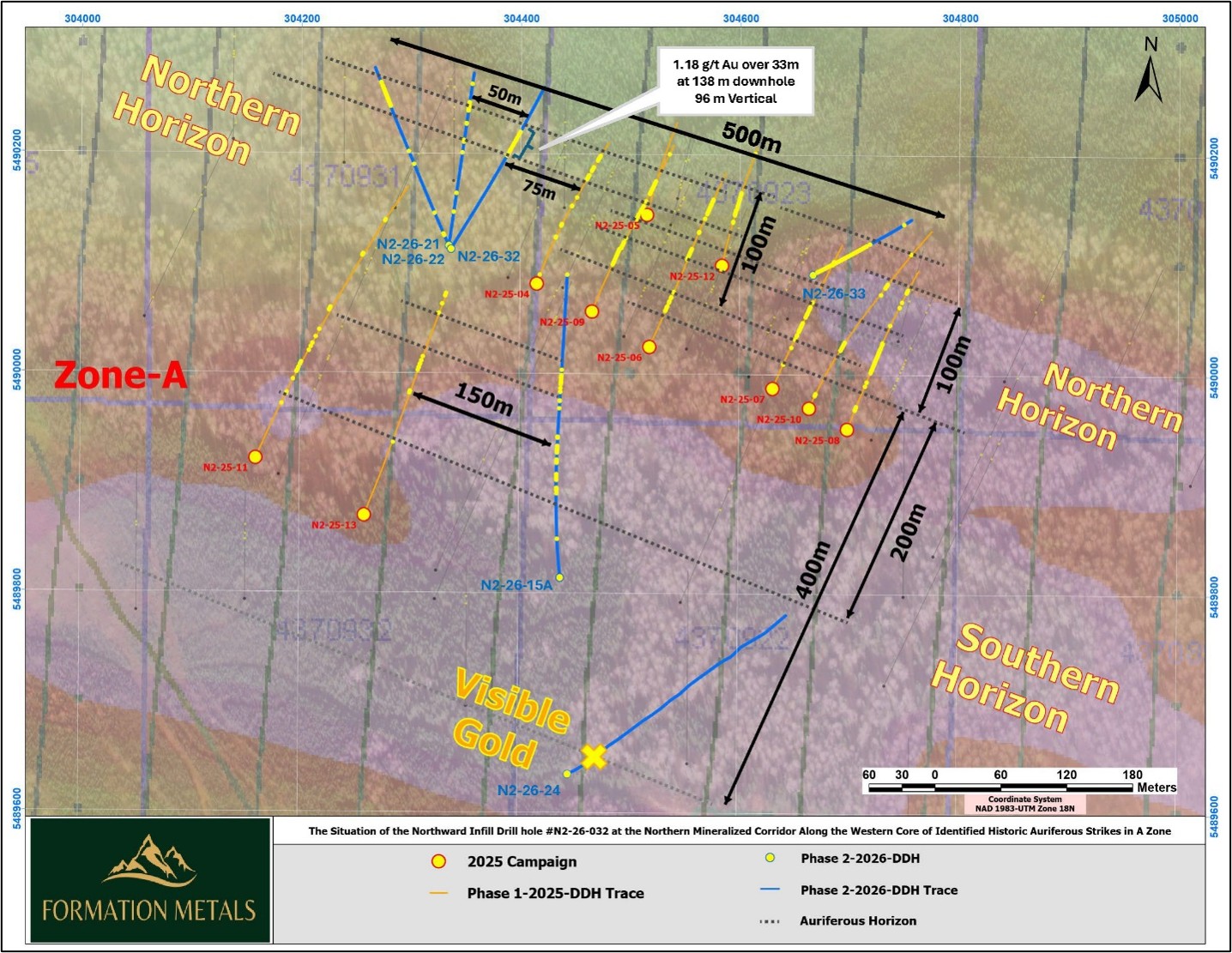
Figure 1 - Plan view of N2-26-032 and the Phase 1 drilling on the northern horizon of the western core of the A-Zone. N2-26-032 confirms the continuity of auriferous strike in the northern horizon along 200 metres of strike.
The Company's drilling campaign has exceeded expectations, confirming geological continuity and delivering robust and continuous gold intercepts including:
Table 1 - Previously Reported Intercepts
Hole | Au (g/t) | Length (m) | From (m) | Vertical depth (m) | Including |
|---|---|---|---|---|---|
N2-25-004 | 0.83 | 40.4 | 180.0 | 147.4 | 1.36 g/t Au over 9.0 m |
N2-25-005 | 0.91 | 42.3 | 14.0 | 9.9 | 2.04 g/t Au over 8.1 m; 1.31 g/t Au over 11.4 m |
N2-25-006 | 1.8 | 21.9 | 154.4 | 133.7 | 3.4 g/t Au over 4.8 m |
N2-25-007 | 1.3 | 22.2 | 139.9 | 121.2 | 2.36 g/t Au over 10.5 m |
N2-25-008 | 0.95 | 61.1 | 109 | 94.4 | 1.68 g/t Au over 26.5 m |
N2-25-009 | 1.37 | 24.0 | 168.9 | 146.3 | 2.05 g/t Au over 13.3 m |
N2-25-010 | 1.43 | 19.4 | 117.5 | 101.8 | 2.23 g/t Au over 7.0 m |
N2-25-012 | 1.75 | 30.4 | 64.1 | 45.3 | 3.51 g/t Au over 10.5 m; 19.2 g/t Au over 0.51 m |
N2-26-15A | 1.41 | 20.6 | 499.1 | 447.5 | 2.63 g/t Au over 5.5 m; 1.78 g/t Au over 7.2 m |
N2-26-021 | 1.05 | 31.0 | 243.0 | 203.8 | 1.89 g/t Au over 12.0 m |
N2-26-022 | 1.34 | 12.5 | 177.2 | 131.7 | 2.29 g/t Au over 6.9 m |
N2-26-033 | 0.98 | 95.6 | 8.4 | 7.1 | 3.14 g/t Au over 10.0 m |
Based on these results, the Company believes the A-Zone hosts a robust mineralized veining system that fluctuates between 20 and 75 metres in thickness, is potentially 300-500 metres wide, with a potential of up to 8 km in strike. The A-Zone remains open in multiple directions, specifically along strike (E-W), up-dip (N) and down-plunge/depth (S).
Drill Results
N2-26-032 was drilled on the northwestern side of the western core of the A-Zone, as an infill hole between the Company's Phase 1 drilling and its western step-out, and returned gold over 33 metres from 138 metres downhole.
Results are also reported for three holes drilled approximately 350 to 500 metres south of the northern horizon (Tables 2 and 3). All three are steep holes that tested at depth south of the horizon rather than across it, and they returned narrow or low-grade intervals. N2-26-024 is the hole in which the Company reported visible gold on April 21, 2026; the sample containing the visible gold returned 1.1 g/t Au over 1.0 metre by metallic screen analysis, and the best interval elsewhere was 0.73 g/t Au over 10.0 metres from 263.0 metres. Results for this hole are partial, with samples from 548 to 644 metres downhole pending. N2-26-020, a 701 metre scout hole, returned a best interval of 0.58 g/t Au over 6.6 metres from 621.3 metres, including 3.94 g/t Au over 0.8 metres. N2-26-015 was abandoned at 207 metres with no significant values and was redrilled as N2-26-15A, reported on September 8, 2026.
Table 2 - Significant Intercepts for N2-26-032, N2-26-020, N2-26-024 and N2-26-015
Hole ID | Au (g/t) | From | To | Length (m) | |
|---|---|---|---|---|---|
N2-26-032 | 1.18 | 138 | 171 | 33 | |
Including | 0.87 | 138 | 152 | 14 | |
Including | 0.82 | 156 | 162 | 6 | |
Including | 7.79 | 168.2 | 171 | 2.8 | |
0.36 | 177 | 178 | 1 | ||
0.42 | 229.5 | 230.9 | 1.4 | ||
N2-26-020 | 0.32 | 33.0 | 39.5 | 6.5 | |
0.37 | 172.0 | 180.5 | 8.5 | ||
1.42 | 196.0 | 197.1 | 1.1 | ||
0.34 | 225.5 | 235.0 | 9.5 | ||
0.17 | 244.4 | 263.5 | 19.1 | ||
0.89 | 286.0 | 288.5 | 2.5 | ||
0.80 | 584.9 | 587.3 | 2.4 | ||
2.33 | 605.2 | 605.8 | 0.6 | ||
0.58 | 621.3 | 627.9 | 6.6 | ||
Including | 3.94 | 627.1 | 627.9 | 0.8 | |
N2-26-024 | 1.10 | 151.0 | 152.0 | 1.0 | |
0.55 | 159.0 | 165.0 | 6.0 | ||
0.38 | 212.0 | 223.0 | 11.0 | ||
0.73 | 263.0 | 273.0 | 10.0 | ||
0.36 | 650.0 | 658.0 | 8.0 | ||
0.20 | 675.2 | 689.3 | 14.1 | ||
N2-26-015 | NSV | 36.6 | 207.0 | 170.4 |
Note 1: Illustrated mineralization intercepts are not directly representative of true width. Based on interpreting the angle of intersection, the estimated true width of the mineralized lens generally corresponds to approximately 66% of the intercepted core length for N2-26-032.
Note 2: Reported intervals are length-weighted averages and composited using a minimum cut-off grade of 0.1 g/t Au for higher-grade intervals. The 33-metre interval in N2-26-032 comprises three mineralized intervals of 14.0, 6.0 and 2.8 metres, separated by 4.0 metres (152.0 to 156.0 metres) and 6.2 metres (162.0 to 168.2 metres) grading less than 0.1 g/t Au. Both are included in the 1.18 g/t Au average at their assayed grades.
Note 3: NSV means no significant values (maximum 0.12 g/t Au). Results for N2-26-024 are partial, with samples from 548 to 644 metres pending; its 1.10 g/t Au interval is the sample containing visible gold, analysed by metallic screen. True widths for N2-26-020, N2-26-024 and N2-26-015 are not known.
Table 3 - Drillhole Information
Drill Hole | Coordinate | Length (m) | Survey | |||
Easting | Northing | Zone | Dip | Azimuth | ||
N2-26-032 | 304337 | 5490113 | 18 | 231 | -45 | N32 |
N2-26-015 | 304438 | 5489814 | 18 | 207 | -74 | N358 |
N2-26-020 | 304117 | 5489984 | 18 | 701 | -79 | N24 |
N2-26-024 | 304446 | 5489635 | 18 | 689 | -73 | N64 |
A key highlight of N2-26-032 is that it remained entirely within a continuous package of sheared and deformed mafic volcanics from top to bottom. This structural zone is characterized by pervasive sericitization, carbonatization, and silicification, alongside quartz and quartz-carbonate veining containing up to 10% disseminated and stringer sulfides, predominantly pyrite, with minor arsenopyrite and sphalerite (Table 4).
Table 4 - Mineralization Summary, N2-26-032
Drill Hole | Mineralized Section (m) | Main Auriferous Interval | |||||
Total (m) | #1 | Length (m) | Interval | Vertical Depth | Mineralization | Au (ppm) | |
N2-26-032 | 216 | 15 m to 231 m (top to bottom) | |||||