

from FireFox Gold Corp (NASDAQ:FFOXF)
FireFox Gold Drills High-Grade and Visible Gold, including 7m @ 11.36 g/t Gold, in Northeast Zone Step-out Hole and Finds New Extensions at the Central Zone, Mustajärvi Project, Lapland, Finland
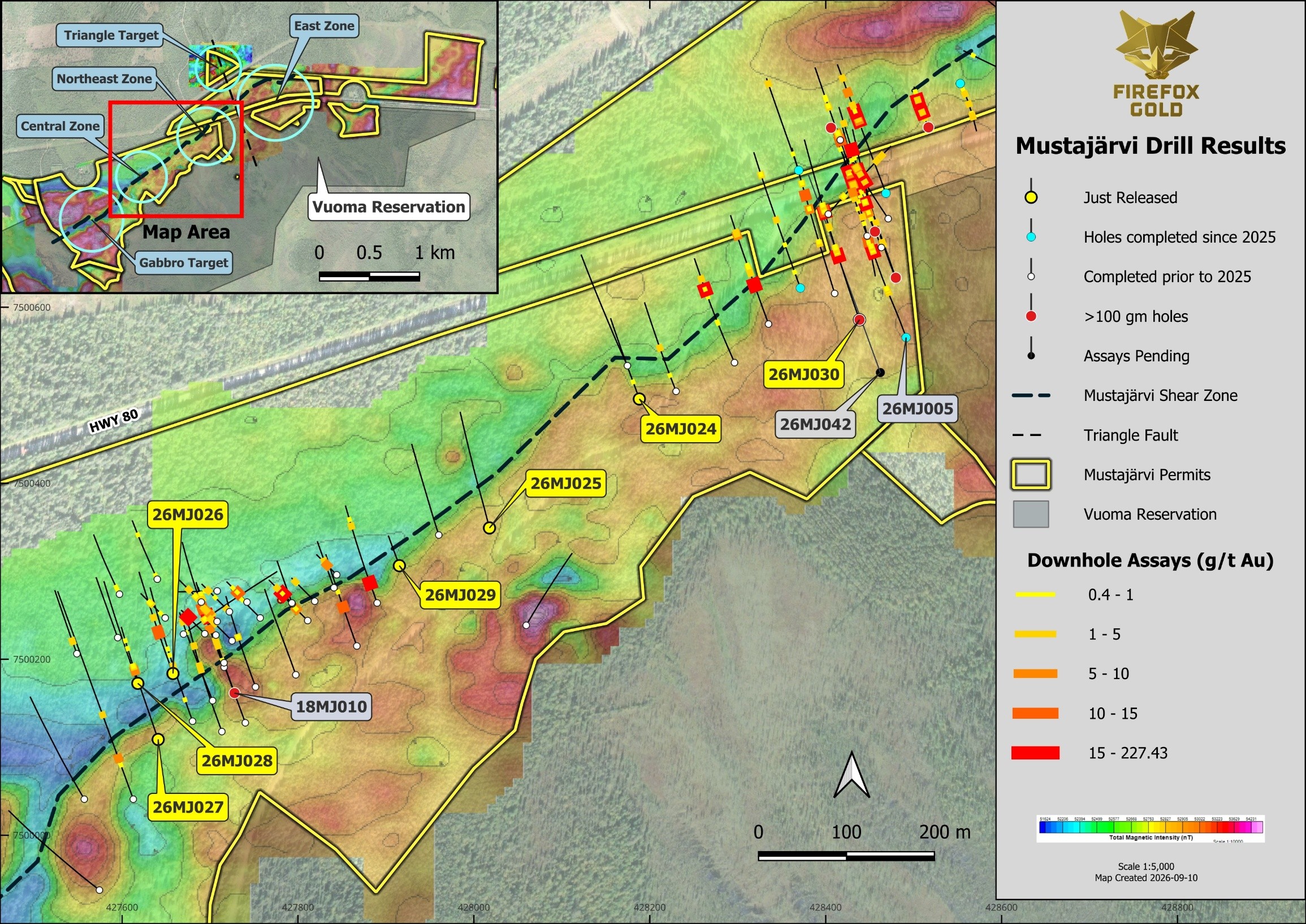
SODANKYLÄ, FI / ACCESS Newswire / September 14, 2026 / FireFox Gold Corp. (TSX.V:FFOX)(OTCQB:FFOXF)("FireFox" or the "Company") is pleased to report assay results from seven additional drill holes completed at its 100%-owned Mustajärvi Gold Project in Lapland, Finland. Most of these holes were drilled well to the southwest from the recent focus at the East Zone, including one hole (26MJ030) that is the first of a two-hole fence testing the western strike extension of the Northeast Zone. The drill also returned to the Central Zone, which has seen only sporadic drilling in recent years, with three holes on the western side of that lode. This round of results also includes three holes into the gap between the Central and Northeast Zones (Figure 1).
Hole 26MJ030 has successfully extended the high-grade core of the Northeast Zone over 50 metres to the west. Highlights of the hole are shown below:
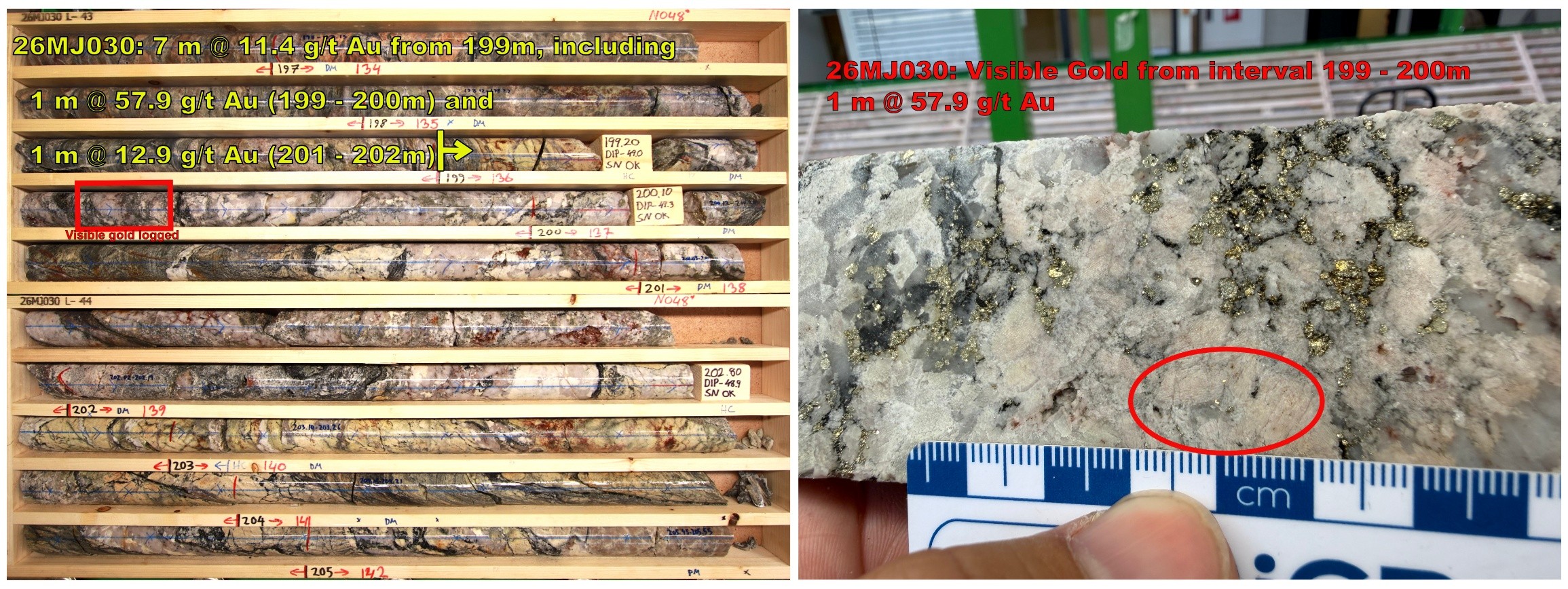
- 26MJ030: 2.0 metres at 44.65 g/t gold from 118.6 metres depth and 7.0 metres at 11.36 g/t gold (with visible gold) from 199.0 metres depth, including 1.0 metre at 57.9 g/t gold, and 11.5 metres at 1.11 g/t gold from 125.6 metres depth.
These new intercepts from the west side of the Central Zone, where alteration along the Mustajärvi Shear Zone appears to be very intense, include high gold grades over good widths at shallow depth:
- 26MJ026: 3.95 metres yielding 6.57 g/t gold from 68.5 metres depth, including 1.0 metre at 14.9 g/t gold from 71.45 metres depth and 0.75 metres at 14.45 g/t gold from 68.5 metres depth (including 1.15m of core loss); and
- 26MJ027: 3.1 metres averaging 2.22 g/t gold, including 0.95 metres at 6.02 g/t gold from 117.15 metres depth.
Carl Löfberg, FireFox's CEO, commented "These latest results from the ongoing Mustajärvi drilling bring significant extensions at both the Northeast and Central Zones. The stacked intercepts in drill hole 26MJ030 are important because they appear to define a southwest continuation from the high-grade core of the Northeast Zone. Our geologists see well developed shearing, brecciated veins hosting visible gold, and broad intervals of intense alteration in this hole, and results are still pending from another hole in the same drill fence. These are the types of learnings that led to the rapid growth of the East Zone in 2022. We took some of this more recent knowledge and experience back to the Central Zone and these new intercepts are really encouraging, as we grow that zone to the west. Given all the excitement at the East and Northeast Zones, it is easy to forget the outlying targets at Mustajärvi that offer so much promise. The drill has recently been at the Gabbro Target (west of Central Zone), the Triangle Target (north of the Northeast Zone), and the geologists have developed a new target called Lammas on what appears to be a parallel shear zone to the east. Our team is at peak productivity now. These are all reasons to stay tuned for our expected continuous news flow."
Mustajärvi Project and Details of Drill Results
The Mustajärvi Project lies along the highway between the cities of Kittilä and Sodankylä, approximately 17 kilometres east of Kittilä. FireFox and predecessor companies drilled approximately 15,752 metres prior to commencement of the current program and delineated three different lodes of gold mineralization along more than two kilometres of strike. Inclusive of these drill holes, the total drilling on the project is now 29,697 metres.
Northeast Zone
Drill hole 26MJ030 is part of a north-westerly directed fence of drilling west from previous high-grade intercepts in the Northeast Zone. Results are pending for 26MJ042, which was collared farther south and undercut the new intervals reported here (see Table 1). Hole 26MJ030 was collared 56 metres west-northwest from hole 26MJ005 (reported on May 5, 2026).
The hole passed through thin glacial sediments, approximately 8.3 metres deep, before entering ultramafic volcanic rocks. The sheared contact with intensely albite- and silica-altered metasedimentary rocks was intercepted at 119.5 metres depth, where strong quartz-carbonate-tourmaline veining hosts 2.0 metres at 44.65 g/t Au. This high-grade intercept in the sheared contact sits atop approximately 15 metres of extremely albitized, sericitized, and veined metasedimentary rock that is cut by a fault at 135.1 metres depth. Much of this altered interval, including the fault, is mineralized with 11.1 metres that averages 1.11 g/t Au.
Over the next sixty metres, the drill bit passed through albite-altered and variably-veined metasedimentary rocks and tuffites. Where quartz-carbonate-tourmaline veining intensifies or the rock is faulted or brecciated, there are narrow intervals of lower grade gold, such as 5.0 metres at 0.59 g/t Au at 169.0 metres depth.
At 199.6 metres depth, there is an interval of quartz-carbonate veins with clots and disseminations of pyrite (7.0 metres at 11.36 g/t Au). The top three metres of this interval is highly brecciated and chaotic, suggesting multiple generations of veining with very high-grade gold, including 1.0 metre at 57.9 g/t Au with visible gold (Figure 2). While pyrite content is often not high, where quartz, carbonate, and tourmaline increase, this long zone of alteration hosts other lower grade intercepts, such as 3.0 metres at 1.14 g/t Au at 210 metres depth. The hole continues through albite-sericite altered metasediments of varying intensity until approximately 300 metres depth, where alteration fades.
Central Zone
Mustajärvi was discovered in the 1990s by Outokumpu with very limited drilling (approximately 12 drill holes for 700 total metres) in the target now known as the Central Zone. A local prospector subsequently extracted a small amount of gold from surface workings in the area. After its first drill program on the property in 2018, FireFox announced a drill intercept of 5.0 metres averaging 18.09 g/t gold, including 2.0 metres of 45.05 g/t gold (See Company news release dated January 21, 2019). Follow-up drilling failed to encounter more encouraging results before the Northeast Zone and East Zone discoveries were made in 2021 and 2022. Since that time, FireFox geologists have utilized oriented drill core, geochemistry, geophysics, and rigorous core logging to develop a more complete geological and structural model for Mustajärvi. The alteration, paragenesis of the mineralization, and structural controls are now much better understood.
Drill holes 26MJ026, 26MJ027, and 26MJ028 were designed as exploration holes to test the westward continuation of the Central Zone along the Mustajärvi Shear Zone. Farther west from this point, Company geologists have identified a large gabbro body that is also cut by large structures exhibiting strong alteration, but gold intercepts have so far been modest. The 2026-2027 drill campaign is prompting re-evaluation of these earlier targets that yielded only moderate success in earlier drilling.
Hole 26MJ026 was collared 58 metres north-northwest of hole 22MJ016 and 59 metres west of hole 21MJ009. The hole passed through approximately 5.6 metres of thin glacial sediments directly into albite-altered metasedimentary rocks. The first mineralized interval was encountered from 64.1 metres depth, returning 1.0 metre at 0.44 g/t Au. This was followed by a thin section of waste before the drill passed into an interval that yielded the most significant result from the hole: 3.95 metres yielding 6.57 g/t Au from 68.5 metres depth, including 1.0 metre at 14.9 g/t Au from 71.45 metres depth and 0.75 metres at 14.45 g/t Au from 68.5 metres depth (including 1.15 metres of core loss). Based on the fragmented drill core and core loss, the gold here is likely associated with a significant fault zone that includes brecciated quartz-carbonate veins and intervals of semi-massive and clots of pyrite.
Deeper in the hole, an additional narrow interval was intercepted from 95.0 metres depth, returning 1.0 metre at 1.07 g/t Au. Gold is associated with pyrite veins as fracture infill in strongly albite- and silica-altered metasediments. This drill hole also encountered seven weakly anomalous intervals associated with quartz-carbonate-tourmaline veins and veinlets containing disseminated pyrite, with grades up to 0.2 g/t Au.
Drill holes 26MJ027 and 26MJ028 are in a north-directed drill fence, along with hole 18MJ007, approximately 40 metres west of 26MJ026. 26MJ027 was collared 77 metres south-southwest of hole 26 and was designed to cut through the overlying ultramafic volcanic rocks to test the sheared contact, which 26MJ026 missed.The hole passed through approximately 6.0 metres of thin glacial sediments before entering bedrock. The drill hole successfully hit the contact between ultramafic volcanic rocks and altered metasediments at 28.85 metres downhole. The first mineralized interval was intercepted at 115.0 metres depth, yielding 3.1 metres averaging 2.22 g/t Au, including 0.95 metre at 6.02 g/t Au from 117.15 metres depth. Gold is associated with replacement-style and fracture-infill pyrite veins and veinlets, together with semi-massive pyrite hosted in fractured, intensely albite- and silica-altered metasedimentary rocks. Another gold-mineralized interval was encountered from 124.0 metres downhole, returning 2.0 metres averaging 1.2 g/t Au hosted in quartz-carbonate-tourmaline-pyrite (QCTP) veining with patchy pyrite.
In the deeper parts of the hole, two additional narrow mineralized intervals occurred between 154.8 and 169.0 metres depth: 1.2 metres at 0.56 g/t Au and 1.0 metre at 0.98 g/t Au.
Drill hole 26MJ028 was collared 41 metres west of 26MJ026 as the middle hole in the drill fence with holes 26MJ027 and 18MJ007. The hole passed through approximately 7.0 metres of thin glacial sediments and entered directly into albite-altered metasediments, just missing the sheared contact. The hole did not return significant gold mineralization, although it did encounter five weakly anomalous intervals associated with strongly deformed and altered intervals. In one interesting interval at depth, anomalous gold is associated with intensely altered and brecciated mafic intrusive rocks.
Northeast to Central Zone Gap
Drill holes 26MJ024, 26MJ025 and 26MJ029 tested various geophysical and structural targets in the gap between the Central and Northeast Zones.
Approximately 200 metres to the west-southwest of hole 26MJ030, drill hole 26MJ024 tested the continuation of mineralization west from the Northeast Zone at an apparent break in the Mustajärvi Shear Zone. The hole is a step-out 42 metres west of hole 19MJ005, which contained some narrow low-grade mineralization. The drill passed through approximately 4.5 metres of thin glacial sediments into the ultramafic volcanic rocks before hitting the contact with the metasedimentary rocks at 21.7 metres downhole. However, the host rocks were only weakly to moderately albite-altered without well-developed veining, so there were only two gold-mineralized intervals: 1.0 metre at 0.61 g/t Au from 29.0 metres depth and 1.0 metre at 0.31 g/t Au from 42.0 metres depth.
Drill hole 26MJ025 was collared 225 metres southwest of 26MJ024 in an area with no previous drilling. The hole passed through approximately 6.5 metres of thin glacial sediments and intersected the contact between ultramafic volcanic rocks and metasediments at 41.1 metres downhole. The hole did not return significant gold mineralization.
Drill hole 26MJ029 was a shallow 50-metre hole to test for potential near-surface continuation of deeper Central Zone intercepts farther west. The hole was collared 111.0 metres southwest of hole 26MJ025 and passed through approximately 9.3 metres of thin glacial sediments before entering bedrock. The drill hole encountered the contact between ultramafic volcanic rocks and intensely altered metasediments at 14.75 metres downhole. There was only one interval of QCTP veinlets with disseminated pyrite that ran above the Company's cut-off grade, starting from 28.0 metres depth and returning 1.0 metre at 0.39 g/t Au.
Table 1. Selected Drill Intercepts in Drill holes 26MJ024 - 26MJ030
(Cut-off Grade 0.3 g/t Au)
Drill Hole | From | To | Interval | Au Grade | |
26MJ024 | 29.0 | 30.0 | 1.0 | 0.61 | |
42.0 | 43.0 | 1.0 | 0.31 | ||
26MJ025 | No significant results | ||||
26MJ026 | 64.1 | 65.1 | 1.0 | 0.44 | |
68.5 | 72.45 | 3.95 | 6.57* | ||
Including | 68.5 | 69.25 | 0.75 | 14.45 | |
Including | 71.45 | 72.45 | 1.0 | 14.9 | |
95.0 | 96.0 | 1.0 | 1.07 | ||
26MJ027 | 115.0 | 118.1 | 3.1 | 2.22 | |
Including | 117.15 | 118.1 | 0.95 | 6.02 | |
124.0 | 126.0 | 2.0 | 1.2 | ||
154.8 | 156.0 | 1.2 | 0.56 | ||
168.0 | 169.0 | 1.0 | 0.98 | ||
26MJ028 | No significant results | ||||
26MJ029 | 28.0 | 29.0 | 1.0 | 0.39 | |
26MJ030 | 118.6 | 120.6 | 2.0 | 44.65 | |
125.6 | 137.1 | 11.5 | 1.11 | ||
169.0 | 174.0 | 5.0 | 0.59 | ||
199.0 | 206.0 | 7.0 | 11.36 | ||
Including | 199.0 | 200.0 | 1.0 | 57.9 | |
210.0 | 213.0 | 3.0 | 1.14 | ||
* Interval includes 1.15 metre of core loss calculated as 0.0 g/t Au. | |||||
All intervals are expressed as core width; true width has not yet been estimated. | |||||
Table 2. Drill Collar Information (coordinates presented in EPSG:3067)
Drill Hole | Easting | Northing | Azimuth (°) | Dip (°) | Depth (m) |
26MJ024 | 428188.1 | 7500495.8 | 340 | 45 | 138.9 |
26MJ025 | 428017.7 | 7500349.2 | 345 | 45 | 193.6 |
26MJ026 | 427657.8 | 7500183.8 | 340 | 45 | 172.6 |
26MJ027 | 427641 | 7500108.9 | 340 | 45 | 190.6 |
26MJ028 | 427617.9 | 7500172.6 | 340 | 45 | 166.8 |
26MJ029 | 427915.3 |