

from Faraday Copper Corp. (CVE:FDY)
Faraday Copper Reports Drill Results Including Near-Surface Copper Mineralization in the American Eagle Area
VANCOUVER, BC / ACCESS Newswire / June 24, 2026 / Faraday Copper Corp. ("Faraday" or the "Company") (TSX:FDY)(OTCQX:CPPKF) is pleased to announce the results of 18 drill holes from its Phase IV drill program at the Copper Creek Project, located in Arizona ("Copper Creek"). Five holes were drilled in the American Eagle area and targeted near-surface copper mineralization. Six holes were drilled near Mammoth and Childs Aldwinkle and had infill, geotechnical and hydrogeological objectives. Seven reconnaissance exploration holes were drilled, with two in the Sunrise trend, three at Marsha's Pocket, one west of Old Reliable and one east of Copper Giant.
Paul Harbidge, President and CEO, commented, "I am pleased with the drill results to date, particularly in the American Eagle area, which continue to increase our confidence in the potential contribution from this area in the next mineral resource update. The identification of oxide copper mineralization east of Copper Giant highlights the opportunity to add further oxide resources and bolster the potential for early cathode production. Additionally, drilling at the Sunrise trend has demonstrated the presence of breccia and porphyry style veins outside of the current resource area and we look forward to further testing these targets."
The primary objective of the current drill program was open pit resource definition, which has now been completed. With the proposed acquisition of the San Manuel Property, drilling has been paused as of June 20, 2026. The Company expects to resume drilling in the fall of 2026 once the proposed acquisition of San Manuel has closed.
Highlights
Intersected near-surface mineralization in four shallow-angled drill holes in the American Eagle area, including:
35.35 metres ("m") at 0.58% copper from 85.40 m, within 71.00 m at 0.41% copper from 80.00 m in hole FCD-26-171; and
67.00 m at 0.30% copper from 30.00 m in hole FCD-26-169.
These drill holes tested the top 50 m below surface, where previous drill data was scarce, and increase the confidence in adding near-surface mineralization.
Identified previously undrilled copper oxide mineralization east of Copper Giant. Intersected 37.00 m at 0.45% copper (0.36% acid soluble copper) from 20.00 m, within 73.00 m at 0.31% copper (0.22% acid soluble copper) starting at surface in drill hole FCD-26-173.
Reconnaissance drilling in the Sunrise trend intersected hydrothermal breccia and porphyry style veins, suggesting the presence of a porphyry centre approximately 1.5 kilometres ("km") south of the American Eagle area, which warrants follow-up drilling.
(For true width information see Table 1)
American Eagle area
The American Eagle area, as mapped on surface, covers approximately 800 m by 1,000 m and is host to numerous prospective breccias and porphyries. These surface expressions are located above the large underground porphyry mineral resource1. Previous drilling by Faraday resulted in the discovery of numerous mineralized breccias including Banjo, Winchester and Prada. Five holes were completed in the area, four of which intersected significant copper mineralization within 40 m from surface.
Drill hole FCD-26-167 was collared approximately 200 m northwest of the American Eagle breccia and drilled at a shallow angle to the northwest, targeting near-surface mineralization near the Jailhouse breccia. It starts in granodiorite to 40 m, followed by igneous cemented breccia to 83 m. Thereafter, the hole intersected alternating porphyry and granodiorite domains to 170 m, where it enters a zone of breccia and porphyry to 222 m. The hole ends in granodiorite. Alteration in the breccia zone is potassic, overprinted by sericite. Mineralization occurs as chalcopyrite with pyrite in breccia cement and porphyry style veins. At the start of the hole, chrysocolla and copper bearing manganese oxide are present.
Drill hole FCD-26-168 was collared west of American Eagle and drilled to the northwest, targeting a possible southwest-ward extension of the Jailhouse breccia trend. The hole intersected granodiorite to 442 m followed by alternating breccia and granodiorite to 503 m. The hole ends in granodiorite. Mineralization is associated with porphyry-style veins and sericite alteration and consists of pyrite and chalcopyrite. Breccias contain locally abundant chalcopyrite and pyrite as cement.
Drill hole FCD-26-169 was collared near the American Eagle breccia and drilled at a shallow angle to the west, targeting near-surface supergene mineralization. The hole intersected granodiorite to 37 m, followed by igneous cemented breccia to 47 m and porphyry to 95 m. Granodiorite is dominant to the end of the hole with an igneous breccia domain from 103 m to 111 m. Mineralization occurs as chalcocite with variable amounts of pyrite and trace chalcopyrite disseminated in porphyry and in porphyry-style veins.
Drill hole FCD-26-170 was collared near the American Eagle breccia and drilled at a shallow angle to the north, targeting near-surface supergene mineralization. After 30 m of granodiorite it intersected breccia to 74 m. Porphyry with some igneous cemented breccia dominates to 105 m. Granodiorite is present to the end of the hole with sections of porphyry from 148 m to 178 m. The breccia domain is strongly oxidized. Chalcocite is present in porphyry style veins together with chalcopyrite and pyrite and in trace amounts throughout the breccia.
Drill hole FCD-26-171 was collared north of the American Eagle breccia and drilled at a shallow angle to the northwest, targeting near-surface supergene mineralization. The hole intersected granodiorite to 43 m, followed by a zone of breccia alternating with porphyry to 121 m before entering granodiorite to the end of the hole. Mineralization occurs as chalcocite together with pyrite in breccia cement and porphyry-style veins. Chalcopyrite is present in trace amounts.
Copper Giant East
Drill hole FCD-26-173 was collared east of Copper Giant and drilled to the south, testing a previously undrilled area for copper oxide mineralization. The hole intersected porphyry for the first 14 m before entering a granodiorite zone with local breccia domains to 92 m. The hole entered porphyry to 132 m and granodiorite to the end of the hole. Copper occurs as chrysocolla, malachite and tenorite as fracture coatings and disseminated in the first approximately 73 m of the hole. Trace chalcocite and chalcopyrite are observed thereafter.
Sunrise trend
The Sunrise trend is located approximately 1.6 km southeast of American Eagle and is characterized by the presence of hydrothermal breccias and several corridors of sericitic alteration controlled by northwest trending faults. Copper oxide occurrences and veins anomalous in precious metals have been identified through geological mapping and sampling. The area has not been drill-tested previously. Two reconnaissance holes, as described below, were drilled and intersected porphyry style veins and hydrothermal breccias. These first reconnaissance holes suggest the presence of a porphyry centre south of and separate from American Eagle. Follow-up drilling is planned.
Drill hole FCD-26-146 was collared at the Sunrise trend and drilled to the northeast, targeting a previously undrilled breccia and structural zone. Breccia cross cutting granodiorite was intercepted from 151 m to 158 m and from 291 m to 345 m. Breccia domains are sericite altered and contain pyrite cement with trace amounts of chalcopyrite. Porphyry style veins with quartz-pyrite and chalcopyrite occur below 350 m.
Drill hole FCD-26-147 was collared at the same location as FCD-26-146 and drilled to the north. It intersected granodiorite to 315 m followed by a zone of alternating breccia and granodiorite to 556 m. Glory hole volcanics are present to 604 m, after which the hole intersected granodiorite once again. Glory hole volcanics were also intersected in the last 20 m of the hole. Breccia domains are sericite altered and contain pyrite cement with trace amounts of chalcopyrite. Porphyry style veins with pyrite and, locally, chalcopyrite occur throughout the hole.
Infill Drilling near Mammoth and Childs Aldwinkle
Seven drill holes tested areas with limited previous drilling near the well-defined and mineralized Mammoth, Childs Aldwinkle, White Bear and Pole breccias. These holes also had geotechnical and hydrogeological objectives.
Drill hole FCD-26-145 was collared near the White Bear breccia and drilled to the east in an area with limited drilling west of the Childs Aldwinkle breccia. The hole stayed in granodiorite for its entire length. Mineralization occurs as pyrite and chalcopyrite and trace amounts of bornite in porphyry style veins. The hole was terminated before the target depth due to drilling equipment challenges and was followed up by drill hole FCD-25-156.
Drill hole FCD-25-156 was collared at the same location as FCD-25-145 and drilled to the southeast in an area with limited drilling west of the Childs Aldwinkle breccia. The hole intersected granodiorite except for a porphyry interval from 580 m to 622 m. Mineralization includes chalcopyrite with pyrite occurring in porphyry-style veins and disseminated within the porphyry interval. This drill hole was also designed for rock-permeability testing for future hydrological models.
Drill hole FCD-26-157 was collared near the White Bear breccia and drilled to the south, collecting drill data between known mineralized centres. It intersected granodiorite for its entire length. Mineralization occurs as pyrite-chalcopyrite with trace chalcocite in porphyry style veins associated with sericitic alteration.
Drill hole FCD-26-158 was collared northeast of Childs Aldwinkle and drilled to the north, targeting a gap in drill coverage. The hole drilled granodiorite to 373 m, followed by porphyry to the end of the hole. A distinct fine grained diorite unit was intersected between 175 m and 214 m. Mineralization occurs as pyrite with chalcopyrite and trace chalcocite in porphyry style veins with sericitic alteration halo. Molybdenite is observed below approximately 400 m downhole.
Drill hole FCD-26-162 was collared north of Childs Aldwinkle and drilled to the north. It is an infill hole designed to collect geotechnical information from a previously undrilled area. The hole intersected granodiorite for its entire length. Mineralization is present as pyrite with trace chalcopyrite and chalcocite in porphyry-style veins.
Drill hole FCD-26-174 was collared west of the Childs Aldwinkle breccia and drilled to the southwest, targeting possible copper oxide mineralization. The hole was in granodiorite for its entire length. Mineralization occurs as tenorite and chrysocolla in fracture coatings near the top of the hole. Trace chalcopyrite and pyrite are present in porphyry style veins below.
Marsha's Pocket
A small breccia and zone of copper oxide in east-striking veins was identified by mapping, approximately 500 m southeast of the Marsha breccia. This area was tested for near-surface mineralization in three short drill holes as described below.
Drill hole FCD-26-153 was collared approximately 500 m southeast of the Marsha breccia and drilled to the south, targeting a small breccia occurrence and vein hosted copper oxide. The hole intersected granodiorite to 42 m, followed by porphyry to 115 m before entering granodiorite to the end of the hole. Mineralization includes pyrite and chalcopyrite and is hosted in porphyry style veinlets with a sericitic alteration halo. Trace malachite and black copper oxides are observed to 40 m.
Drill hole FCD-26-154 was collared at the same location as FCD-26-153 and drilled to the northwest at a shallow angle, targeting porphyry style veins with copper oxide at surface. The hole intersected granodiorite for its entire length except for porphyry from 65 m to 89 m. The hole remained in the oxidized or partially oxidized domain with mineralization occurring as trace chrysocolla and black copper oxides on fracture coatings.
Drill hole FCD-26-155 was collared at the same location as FCD-26-153 and drilled to the west. It intersected granodiorite to 13 m, followed by porphyry and igneous cemented breccia to 30 m, before returning to granodiorite. From 38 m to 71 m, the dominant lithology is breccia, followed by porphyry to the end of the hole. Malachite together with tenorite make up the copper mineralization at the top of the hole. The hole remained in the fully or partially oxidized zone to 78 m. Below that depth, trace pyrite occurs disseminated, in veinlets and as breccia cement.
Old Reliable West
West-trending veins with locally intense sericite alteration and breccia occurrences, cross cutting Glory Hole volcanics, are observed west of the Old Reliable breccia.
Drill hole FCD-26-164 was collared northwest of Old Reliable and drilled to the southwest. It drilled through alternating breccia and Glory Hole volcanics to 186 m, before entering granodiorite for the remainder of the hole. Breccia domains are affected by sericitic alteration with pyrite in the cement. Chalcopyrite occurs locally in a small breccia at the contact between Glory Hole volcanics and granodiorite.
Phase IV Drill Program: Next Steps
To date, the Company has released results from 15,050 m drilled in 53 holes. The assay results for additional completed drill holes will be released as they are received, analyzed and confirmed by the Company.
The primary objective of the current drill program was open pit resource definition, which has now been completed. With the proposed acquisition of the San Manuel Property, drilling has been paused as of June 20, 2026. The Company expects to resume drilling in the fall of 2026 once the proposed acquisition of San Manuel has closed.
Figure 1: Plan View Showing Surface Geology and Location of Drill Holes
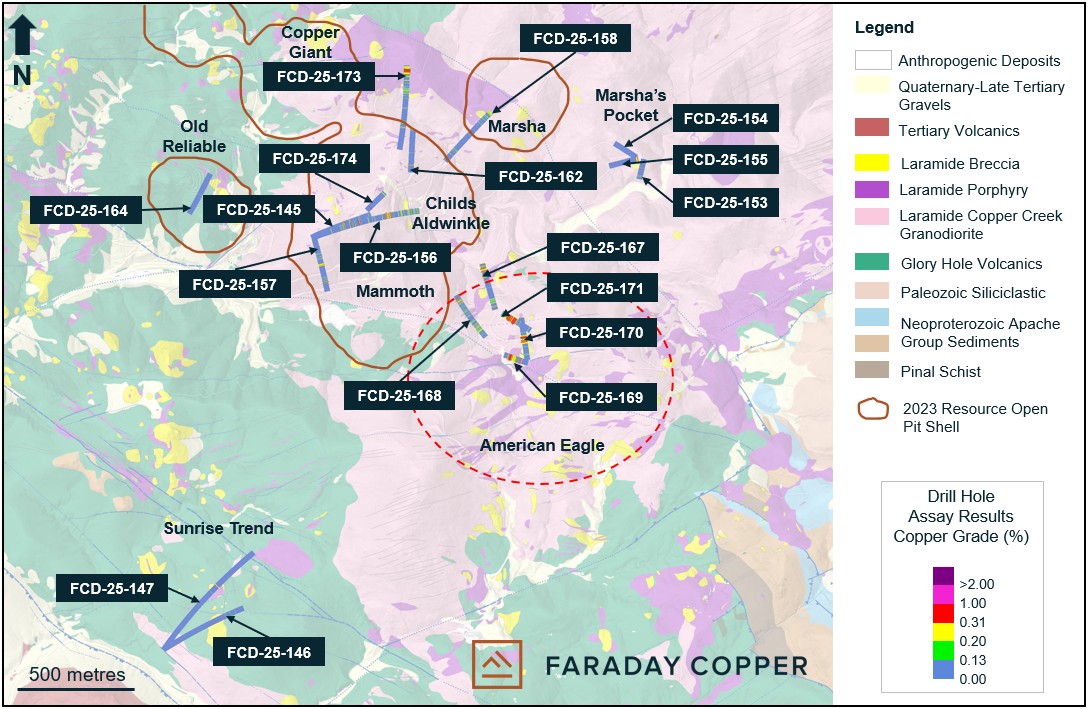
Note: The open pit shell is based on constraints used in the Mineral Resource Estimate ("MRE") as presented in the Copper Creek Project Technical Report1.
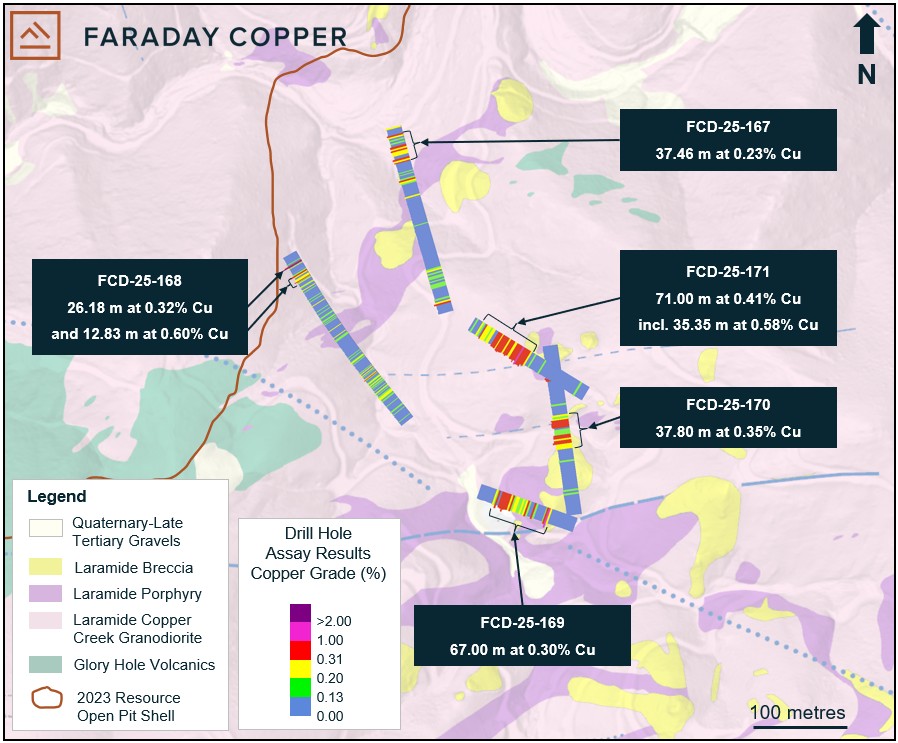
Note: The open pit shell is based on constraints used in the Mineral Resource Estimate ("MRE") as presented in the Copper Creek Project Technical Report1.
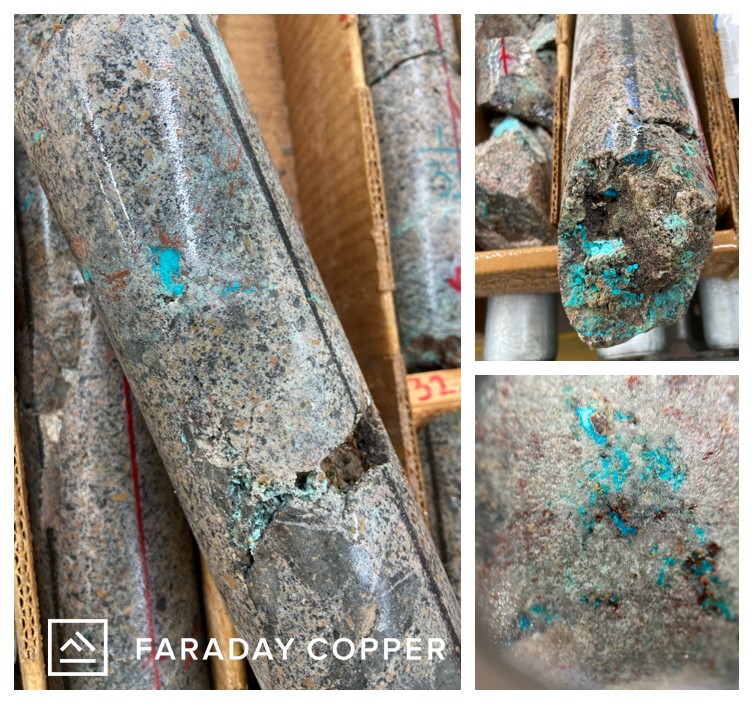
Table 1: Selected Drill Results
Drill Hole ID | From | To | Length | True Width | Total Cu | Sol Cu | Sol Cu / Total Cu | Au | Ag | Mo |
(m) | (m) | (m) | (m) | (%) | (%) | (g/t) | (g/t) | (%) | ||
FCD-26-145 | 260.00 | 276.33 | 16.33 | 16 | 0.22 | N/A | N/A | N/A | 0.66 | 0.0004 |
FCD-26-156 | 246.83 | 270.00 | 23.17 | 23 | 0.13 | N/A | N/A | N/A | 0.66 | 0.0011 |
and | 314.15 | 324.00 | 9.85 | 9 | 0.25 | N/A | N/A | N/A | 1.72 | 0.0010 |
and | 368.00 | 392.00 | 24.00 | 24 | 0.37 | N/A | N/A | N/A | 0.76 | 0.0016 |
and | 575.00 | 622.46 | 47.23 | 47 | 0.23 | N/A | N/A | 0.01 | 0.62 | 0.0014 |
and | 694.00 | 838.00 | 144.00 | 144 | 0.13 | N/A | N/A | N/A | 0.46 | 0.0016 |
FCD-26-153 | 93.00 | 104.80 | 13.80 | 13 | 0.13 | N/A | N/A | N/A | 0.86 | 0.0004 |
and | 168.00 | 188.00 | 20.00 | 20 | 0.15 | N/A | N/A | N/A | 0.46 | 0.0005 |
FCD-26-155 | 0.00 | 9.45 | 9.45 | 9 | 0.38 | 0.33 | 0.85 | N/A | 1.73 | 0.0006 |
FCD-26-157 | 159.00 | 173.00 | 14.00 | 14 | 0.23 | 0.01 | 0.02 | N/A | 1.13 | 0.0004 |
and | 273.00 | 285.00 | 12.00 | 12 | 0.19 | N/A | N/A | N/A | 0.96 | 0.0006 |
FCD-26-158 | 91.00 | 105.00 | 14.00 | 14 | 0.13 | 0.01 | 0.05 | N/A | 0.25 | 0.0006 |
and | 429.00 | 446.35 | 17.35 | 17 | 0.19 | N/A | N/A | N/A | 0.21 | 0.0028 |
FCD-26-167 | 0.00 | 19.23 | 19.23 | 19 | 0.16 | 0.04 | 0.34 | N/A | 0.63 | 0.0011 |
and | 32.34 | 58.00 | 25.66 | 25 | 0.15 | <0.01 | 0.03 | N/A | 0.54 | 0.0004 |
and | 199.54 | 237.00 | 37.46 | 37 | 0.23 | N/A | N/A | 0.01 | 1.90 | 0.0015 |
FCD-26-168 | 78.00 | 176.00 | 98.00 | 98 | 0.14 |