

from Aclara Resources Inc. (CVE:ARA)
Aclara Announces Filing and Results of Feasibility Study for Its Flagship Carina Project
After-tax NPV8 of US$1.7 Billion based on Mineral Reserves
TORONTO, ON / ACCESS Newswire / April 13, 2026 / Aclara Resources Inc. ("Aclara" or the "Company") (TSX:ARA) is pleased to announce the filing and results of the feasibility study (the "FS") of the Company 's flagship asset, the Carina Project ("Carina" or the "Project") based on Mineral Reserves.
The FS, titled "NI 43-101 Technical Report & Feasibility Study on the Carina Project, Goiás, Brazil" with an effective date of March 20, 2026, was prepared in accordance with National Instrument 43-101 - Standards of Disclosure for Mineral Projects ("NI 43-101") by Hatch Consultoria em Projetos Ltda. ("Hatch") with contributions from L&M Geociencias SpA, Promet 101 Consulting Pty Ltd, Abelco Consulting SpA, LOM Consultoria em Mineração Ltda ("LOMC"), ERM Consultants Canada Ltd and Argus Media Ltd ("Argus Media").
The terms "Mineral Resource," "Inferred Mineral Resource," "Indicated Mineral Resource," "Measured Mineral Resource," "Mineral Reserve," "Probable Mineral Reserve," and "Proven Mineral Reserve" referenced in this news release, have the meanings given to them in NI 43-101 by reference to the "Definition Standards for Mineral Resources and Mineral Reserves" (2019) of the Canadian Institute of Mining and Metallurgy.
The FS has been filed and can be found under the Company's profile on SEDAR+ (www.sedarplus.ca) and on Aclara's website (www.aclara-re.com).
Aclara's COO, Hugh Broadhurst, commented:
"Completing a Feasibility Study only six months after our Pre-Feasibility Study is a significant achievement, and I want to recognize the dedicated effort of our team and technical partners who made it possible. The level of engineering detail we are presenting today is substantial - and it reflects the considerable work that has gone into the Carina Project from the very beginning. We remain the only company in the world to report heavy rare earth Mineral Reserves from ionic clays in accordance with NI 43-101. We have demonstrated our metallurgical process via a continuously operated pilot plant. This FS builds on such foundation with a level of rigor appropriate to the significance of the Project. Our path to market via our 100% owned separation facility that is planned to be built in Louisiana, USA, further derisks the Carina Project and supports our strategy to sell reliable and traceable rare earths to high-end customers. This firmly establishes our initial supply chain entirely in the American continent. Our high-purity product, sustainable process design, and integrated mine-to-magnet strategy are now underpinned by engineering from one of the world's leading firms. We will continue to work to improve our technology, which, in the medium term, we also plan to apply in Brazil and other countries where we operate. The world needs a concrete, independent, and resilient supply of heavy rare earths - and Aclara is built to deliver exactly that."
Highlights
Significant Production of Heavy Rare Earths (HREEs) and Light Rare Earths (LREEs) for an 18-year Life of Mine ("LOM")
Average annual production [1] of 4,378 tonnes rare earth oxides (REO) contained in a mixed rare earth concentrate ("MREC") product with very high content of Dysprosium and Terbium (DyTb) and Neodymium and Praseodymium (NdPr) of 4.2% and 27.2%, respectively.
Average annual production 1 of magnetic elements as well as other strategic HREEs contained in the MREC product:
156 tonnes Dysprosium (Dy) and 27 tonnes of Terbium (Tb);
1,191 tonnes NdPr; and
Other strategic HREE: 173 tonnes of Samarium (Sm), 176 tonnes of Gadolinium (Gd), 10 tonnes of Lutetium (Lu) and 1,160 tonnes of Yttrium (Y).
Carina's future production of DyTb is equivalent to approximately 11.8% of China's 2024 estimated DyTb production [2] .
Strong Economics
After-tax Net Present Value ("NPV") of approximately US$1.7 billion, at an 8.0% discount rate, based on Argus Media price forecasts.
After-tax Internal Rate of Return ("IRR") of 26.9%, with a payback period of 2.9 years.
Initial capital cost ("Construction Capex") of US$678.2 million, plus a US$102.7 million contingency, for an aggregate of US$780.9 million. This figure is US$100.4 million higher than the Company's previously reported Construction Capex in its Pre-Feasibility Study which is primarily due to foreign exchange ("FX"), inflation, and higher engineering accuracy.
An average annual commercial 1 discount of US$314.4 million - equivalent to 34% of the annual gross revenue - has been applied to account for the full separation of the Carina Project's MREC. Aclara's plans consist of paying this separation fee to its separation project in Louisiana. The NPV associated with Aclara's future separation facility in Louisiana is not included in the FS.
Average annual net revenue 1 of US$599 million and average annual earnings before interest, taxes, depreciation, and amortization ("EBITDA") 1 of approximately US$460 million.
High average Net Smelter Return ("NSR") of US$61.8 per tonne processed, against a low average production cost of US$13.1 per tonne processed.
The price forecast scenario developed by Argus Media is based on the European price index (excluding China) and has been calculated on real terms.
High Confidence in the Production Forecast, the Process Flowsheet and the Product Quality
High geological confidence supported by 30,384 m of drilling across 1,990 drillholes, representing a 24.0% increase in drilling compared to the previously reported Mineral Resource Statement on October 1, 2025 and a 640.0% increase in drilling compared to the Inferred Mineral Resource Statement on August 6, 2024. Carina has become the first ionic clay project to declare Mineral Reserves in accordance with NI 43-101.
Successful completion of the Project's representative pilot campaign at its semi-industrial scale facility in Goiânia, Brazil. This marks the third pilot campaign conducted by Aclara over the past three years, focused on optimizing OPEX and CAPEX, and validating the process parameters and robustness of its proprietary Circular Mineral Harvesting process.
Increased quality of Carina's MREC from 91.9% to over 95.0% purity (97.7% according to the design mass balance) [3] supported by samples produced at semi-industrial scale plant.
Circular Mineral Harvesting process designed to minimize environmental impact: it does not use explosives; there is no crushing nor milling; approximately 93.0% of the water used is recirculated; the main reagent is a common fertilizer and is recirculated with 99.0% efficiency; and no requirement for a tailings dam.
Minimal carbon footprint supported by a combination of low energy consumption, elimination of explosives, crushing, grinding and milling and a high percentage of renewable energy within the Brazilian power grid.
Expedited Path to Early Production
The Company plans to start early works on site by Q3 2026 as part of the Construction Capex. These include camp construction, road improvements and certain ancillary infrastructure to prepare the site for full fast-track construction in 2027.
The FS incorporates a modularization strategy that enables parallel fabrication and site preparation, reducing dependence on local labor availability and weather, improving construction quality control, and compressing the overall Project schedule.
Commissioning is estimated to commence in H1 2028, with initial production in H2 2028 and ramp-up through 2029.
Vertical Integration: Strong Bedrock for Integration with Aclara's Processing Hub in Louisiana ("Project Dynamo")
The Project's high-purity MREC has been designed to facilitate further processing at Project Dynamo, where it will be separated into high-purity individual rare earth oxides and converted into metals and alloys under the specifications of magnet manufacturers.
Project Dynamo's proprietary processing technologies are advancing through validation across two fronts:
The rare earth separation pilot plant at Virginia Tech is fully operational and on track to produce first separated NdPr, Dy and Tb using MREC from the Project.
Through Aclara Metals, a 50/50 joint venture with CAP S.A. ("CAP"), a demonstration plant is underway to produce rare earth metals and alloys using molten salt electrolysis technology.
Downstream processing is complemented by a strategic alliance with permanent magnet manufacturer aimed at developing a complete mine to magnet solution.
Strong Financial Backing
Two of Aclara's key shareholders Hochschild Mining PLC and CAP, provide significant operational experience and financial support to continue advancing the Project.
The U.S. International Development Finance Corporation has committed up to US$5 million in project development funding for the Project's feasibility study and has a preferential option to further invest in the Project when the Company seeks to raise additional financing of more than US$50 million in a single transaction, or US$75 million or more in multiple financing events within a period of twelve months.
Key Project Parameters
Table 1 and Table 2 summarize the relevant parameters associated with the FS operating and financial metrics :
The FS is based on Mineral Reserves.
The after-tax NPV is estimated at US$1.7 billion, using an 8.0% discount rate.
The REE price forecast provided by Argus Media based on European prices (excluding China) aligns well with market environment of export restrictions from China on HREEs [4] and future supply/demand dynamics.
LOM average realized prices were assumed at US$3,609/kg for Tb, US$1,640/kg for Dy, US$251/kg for Y, US$338/kg for Gd, and US$157/kg for NdPr and an overall REO basket price of US$209/kg.
Table 1: Key Project Operating Parameters
FS | |||
Unit | Total | Annual Average* | |
Mining and Processing | |||
Life of Mine | Years | 18 | - |
Total Process Plant Feed | million tonnes (dry) | 170.8 | 9.7 |
Total Waste Mined | million tonnes (dry) | 38.4 | 2.0 |
Strip Ratio | - | 0.2 | 0.2 |
Production | |||
Total Rare Earth Oxides | Tonnes | 76,437 | 4,378 |
Neodymium & Praseodymium (NdPr) | Tonnes | 20,736 | 1,191 |
Dysprosium (Dy) | Tonnes | 2,726 | 156 |
Terbium (Tb) | Tonnes | 468 | 27 |
*Note: Annual average does not include the first year of ramp-up and the last year of ramp-down
Table 2: Key Project Financial Parameters
FS | |||
Unit | Total | Annual Average* | |
Financials | |||
Net Revenue | US$ million | 10,478 | 599 |
NSR | US$/t | 61.8 | - |
Basket Price (2029-2033) | US$/kg | 171.0 | - |
Basket Price (LOM) | US$/kg | 209.0 | - |
Production Cost | US$ million | 2,234 | 127 |
Unit Cost per tonne of clay processed | US$/t processed | 13.1 | - |
Unit Cost per kg of REO produced | US$/kg REO | 29.2 | - |
Unit Cost per kg of Dy_Eq produced | US$/kg Dy_Eq** | 303.8 | - |
EBITDA | US$ million | 8,027 | 461 |
EBITDA Margin | % | 76.6% | - |
Income Tax | US$ million | 2,435 | 143 |
Effective Tax Rate | % | 34% | - |
Construction Capex | US$ million | 678.2 | - |
Construction Capex Contingency | US$ million | 102.7 | |
Total Construction Capex | US$ million | 780.9 | - |
Royalty Purchase Cost | US$ million | 6.5 | - |
Sustaining Capex | US$ million | 56.7 | - |
Financial Returns | |||
Pre-Tax NPV (8.0%) | US$ million | 2,663 | - |
Pre-Tax IRR | % | 33.6% | - |
Pre-Tax Payback | Years | 2.7 | - |
Post-Tax NPV (8.0%) | US$ million | 1,661 | - |
Post-Tax IRR | % | 26.9% | - |
Post- Tax Payback Period | years | 2.9 | - |
Notes:
* Annual average does not include the first year of ramp-up and the last year of ramp-down
** DyEq US$/kg unit cost calculated only using credits of the net revenue of NdPr and Tb applied to the total costs
Post-Tax Free Cash Flow
Figure 1 demonstrates the yearly and cumulative post-tax free cash flow generated through the LOM.
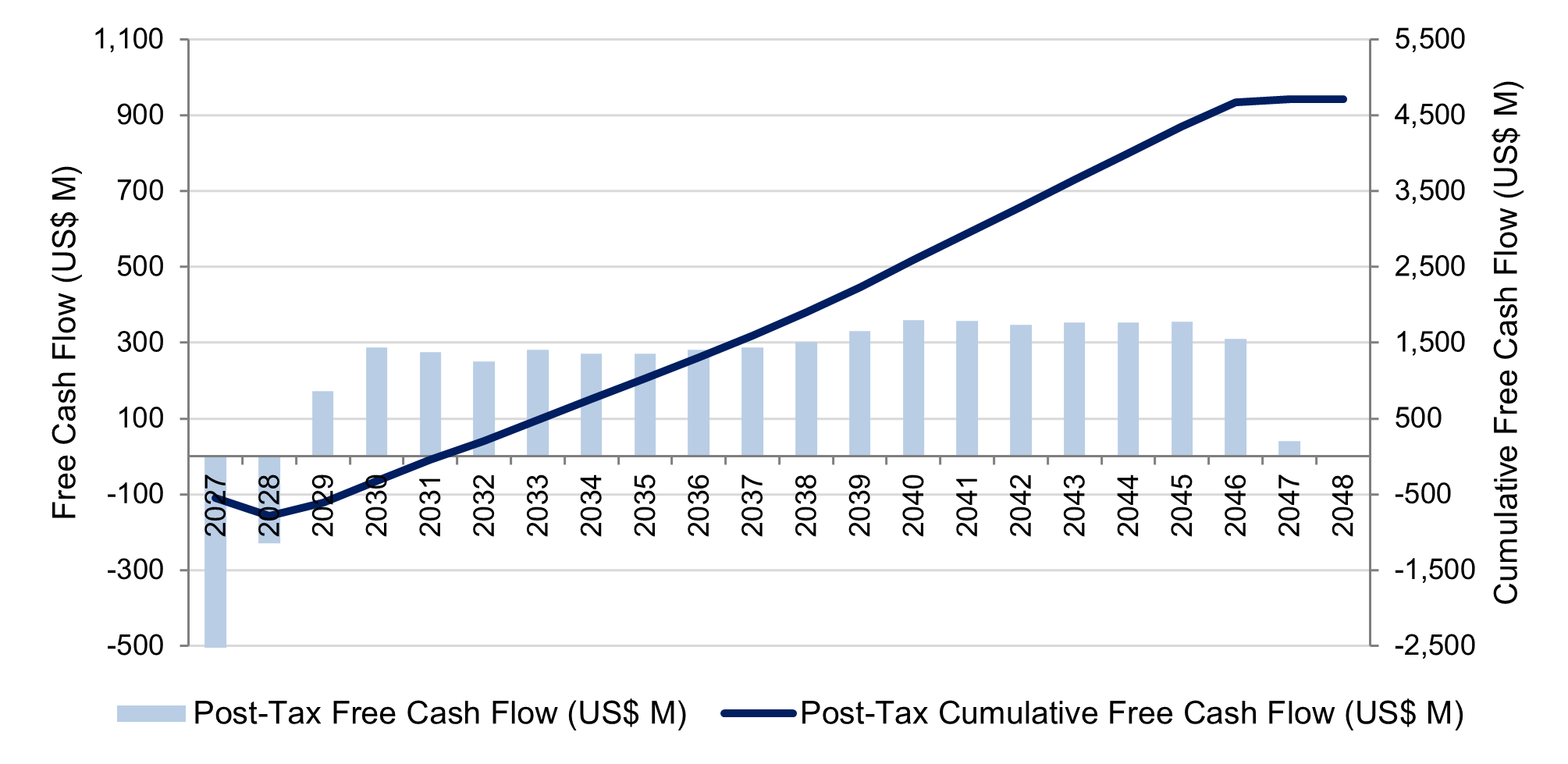
Figure 1: Projected life of mine, post-tax, unleveraged free cash flow
Sensitivity Analysis
A sensitivity analysis was undertaken to evaluate the impact on post-tax NPV, considering a variation of ±30.0% for five key input variables: MREC sale price, Separation Cost, Desorption Efficiency, OPEX and CAPEX (Figure 2).
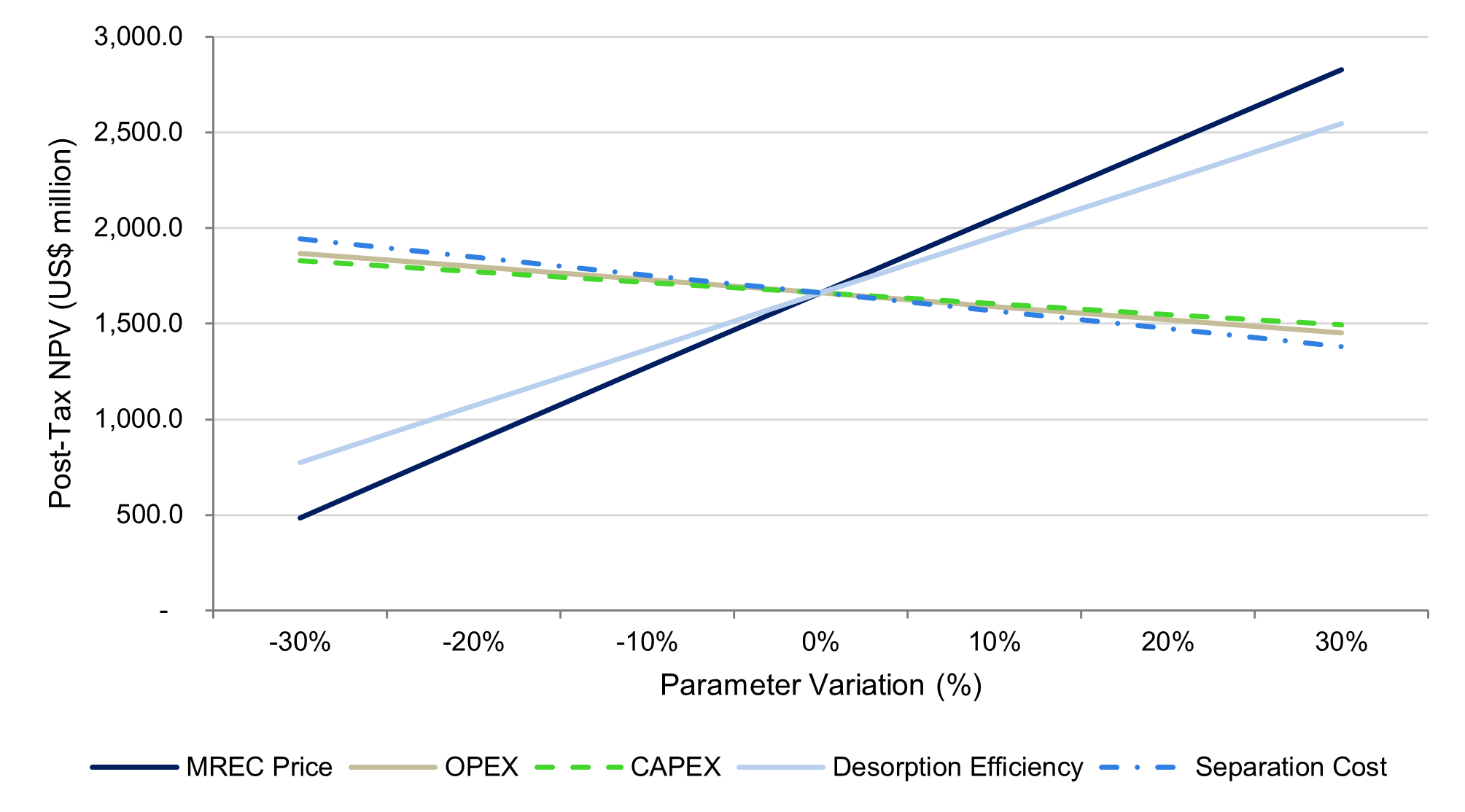
Figure 2 : Sensitivity analysis testing the impact on NPV
The economic analysis of the estimated cashflows for the Project indicates the potential for an economic project across a broad range of input assumptions. The NPV calculated at an 8.0% discount rate is positive, and the IRR calculated for the project is within a favourable range.
The primary commercial risks include:
The applied REE price forecast could be significantly different than modeled. The applied European price forecast developed by Argus Media assumes an independent supply chain outside of China. The supply chain outside of China is not yet fully developed and China could influence the market through government intervention which could significantly lower prices relative to those applied in the economic analysis.
The applied separation cost is based on an incentive price estimate for Aclara's separation project in the United States, calculated based on FEL1-level engineering capital and operation costs. There is a risk that these capital and operating costs will increase as the separation project is completed, which will increase the separation cost charged to the Project.
Mineral Resource Statement
The Project 's Mineral Resources have been estimated using the results obtained from 30,384 m of drilling across 1,990 drillholes and 16,196 samples. The Mineral Resource Estimate is reported in accordance with the requirements of NI 43-101.
Table 3. Carina Project Mineral Resource Estimate (Effective January 2026)
Mineral Resources Classification | Mass (Mt) | Total Oxide Grade (ppm) | Oxide Content (t) | ||||||
TREO | NdPr | Dy | Tb | TREO | NdPr | Dy | Tb | ||
Measured | 27.0 | 1,822 | 355 | 59 | 9.6 | 49,182 | 9,597 | 1,602 | 260.4 |
Indicated | 233.8 | 1,585 | 295 | 43 | 6.9 | 370,649 | 69,067 | 10,089 | 1,622.5 |
Measured & Indicated | 260.8 | 1,610 | 302 | 45 | 7.2 | 419,832 | 78,664 | 11,691 | 1,882.9 |
Inferred | 41.3 | 1,318 | 244 | 42 | 6.7 | 54,433 | 10,068 | 1,754 | 276.9 |
Notes:
Mass is expressed in million tonnes (dry, metric).
TREO means total rare earth oxides (La2O3, CeO2, Pr6O11, Nd2O3, Sm2O3, Eu2O3, Gd2O3, Tb4O7, Dy2O3, Ho2O3, Er2O3, Tm2O3, Yb2O3, Lu2O3, and Y2O3).
NdPr means neodymium and praseodymium (Nd2O3 and Pr6O11).
Dy means dysprosium (Dy2O3) and Tb means terbium (Tb4O7).
Mineral Resources were reported at a NSR cut-off of US$10.42/t, constrained within a conceptual pit shell using average long term metal prices and metallurgical recoveries, both outlined in Chapter 14 of the FS.
Mineral Resources that are not Mineral Reserves do not have demonstrated economic viability. Mineral Resources are reported inclusive of Mineral Reserves. The estimate of Mineral Resources may be materially affected by environmental, permitting, legal, title, taxation, socio-political, marketing or other relevant issues.
The FS Mineral Resource estimate was prepared by Andres Beluzan, Member of Chilean Mining Commission, an independent Qualified Person ("QP") as defined by NI 43-101.
Totals may not be balanced due to rounding of figures.
Mineral Reserves Statement
Mineral Reserves, which include the identified economic portion of the Measured and Indicated Mineral Resources, were estimated by LOMC for the Project as part of the FS.
To convert Mineral Resources to Mineral Reserves, consideration was given to forecasts and estimates of REE prices, metallurgical recovery, mining dilution and ore loss factors, royalties and costs associated with mining, processing, overheads, and logistics. These parameters were used to derive economic cut-offs and create a feasible pit design based on geotechnical assumptions, a production schedule and a financial model. It is LOMC's opinion that the Mineral Reserve estimation is compliant with NI 43-101.
Table 4: Carina Project Mineral Reserve Estimate (Effective March 20 th, 2026)
Mineral Reserves Classification | Mass (Mt) | Total Oxide Grade (ppm) | Desorbable Oxide Grade (ppm) | ||||||
TREO | NdPr | Dy | Tb | TREO | NdPr | Dy | Tb | ||
Proven | 22.2 | 1,856 | 375 | 60 | 9.9 | 514 | 137 | 20 | 3.6 |
Probable | 148.6 | 1,728 | 337 | 47 | 7.6 | 458 | 125 | 16 | 2.8 |
Proven & Probable | 170.8 | 1,745 | 342 | 49 | 7.9 | 465 | 127 | 17 | 2.9 |
Notes:
The REE prices assumed are: US$93.88/kg Pr oxide, US$93.88/kg Nd oxide, US$3,568.94/kg Tb oxide, US$1,178.78/kg Dy oxide.
An exchange rate of R$5.50 to US$1.00 is assumed.
The economic cut-off was calculated cell-by-cell as ore/waste mining costs vary with haul distances. For equal haul distance, the economic NSR cut-off is US$9.89/t (diluted).
2.0% dilution and 98.0% mining recovery factors were applied to grades and tonnages, respectively.
The Mineral Reserve is included in the Mineral Resource.
Totals may not be balanced due to rounding of figures.
A separate economic model was run using more conservative metal price assumptions for pit optimization, assigning no value to rare earths other than NdPr, Dy, and Tb. Under these conditions, the Project generates a positive NPV, confirming the economic viability of the Mineral Reserves.
Project Description
The Project is based on standard open pit extraction techniques using 95-tonne hydraulic excavators and 75-tonne payload haulage trucks to extract and deliver the ore to the process plant. The processing plant has been located close to the centre of mass of the mining operation to minimise the total haulage distance over the LOM. Given the friable nature of the clays and the shallow depth of the extraction zones, no aggressive nor energy-intensive techniques such as drilling and blasting are required to extract the clays from the pits.
Once the clay is delivered to the process plant, it will be washed using an ammonium sulfate solution to extract the REEs from the clay surfaces. No crushing, grinding nor milling is needed to free the REEs from the clays as they are extracted through a non-invasive ion-exchange process whereby ammonium ions replace REE ions on the surface of the clay thereby liberating the REEs into solution. The REEs in solution are then isolated through a pH-adjusted precipitation process and then passed through a high-pressure filter to remove any remaining liquids. This results in the production of a high-purity REE carbonate ready for shipment to the Company ' s separation facility in Louisiana. The process plant will have an average MREC production rate [5] of 4,378 t/year of REO at 90.0% availability.
Any unwanted impurities such as aluminium and calcium extracted from the clays during the ion exchange process are removed through a selective precipitation process and subsequently recombined with the washed clays before transportation to the deposition zone which is a filter-stack storage facility.
An integrated water recovery system purifies and regenerates the remaining process liquors so they can be reintroduced into the feed. The treated water is recycled in a closed circuit to reduce water consumption. This allows the processing plant to operate with min